

Running a small business in 2026 is both exciting and exhausting. You’re not just the owner you’re also the marketer, customer support agent, accountant, and strategist. Managing all of this manually can slow down your growth and burn you out.
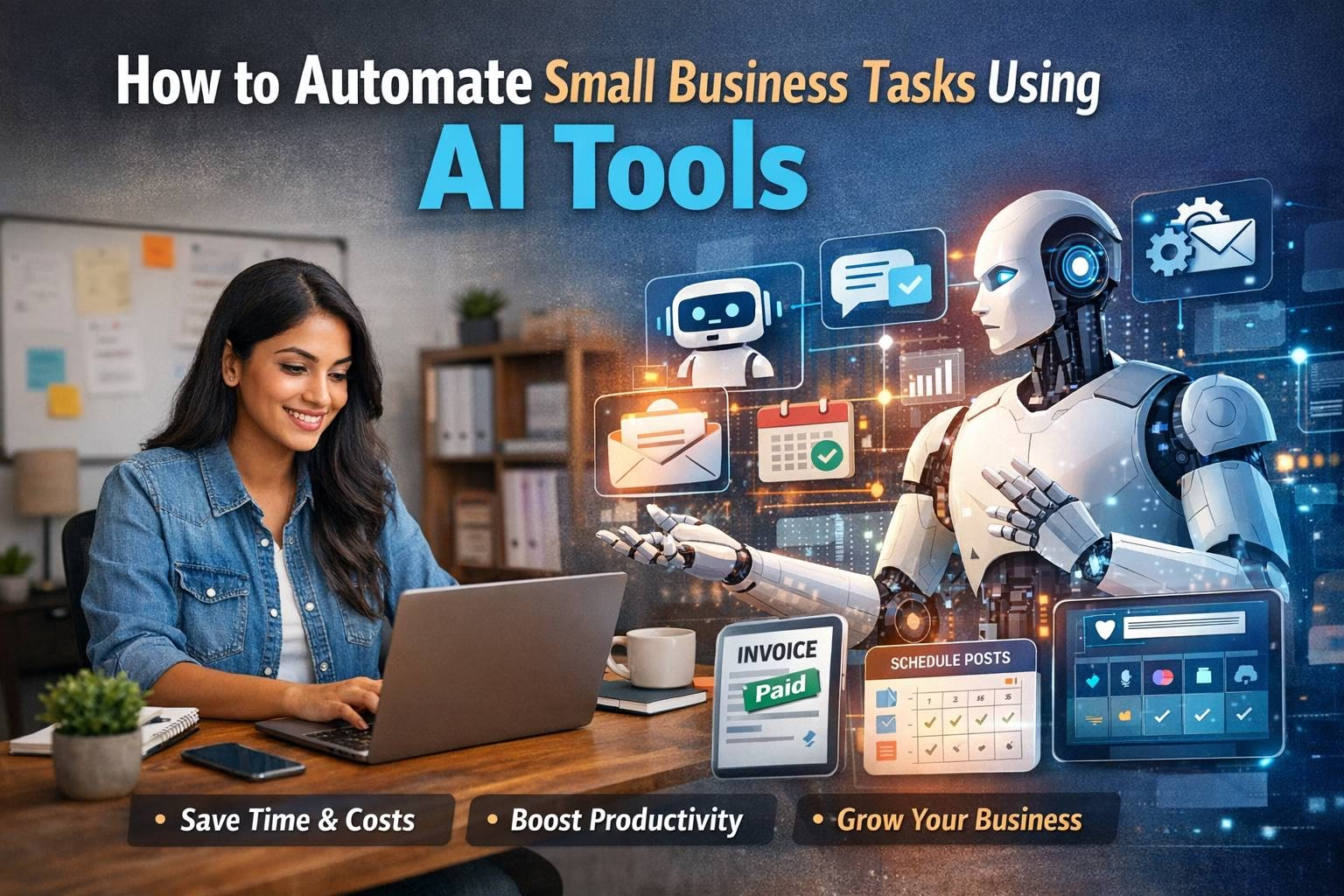
If you’ve ever searched for “how to automate small business tasks using AI tools”, you’re likely looking for practical, easy-to-implement solutions not complicated technical jargon. This guide is built exactly for that.
That’s where AI automation comes in.
By the end of this article, you’ll understand:
- What AI automation actually means
- Which business tasks you can automate today
- The best AI tools to use
- Step-by-step ways to implement automation
- Real examples and strategies for beginners
Table of Contents
What is AI Automation for Small Businesses?
AI automation refers to using artificial intelligence tools to perform repetitive, rule-based, or time-consuming tasks without constant human involvement.
Unlike traditional automation, AI tools can:
- Learn from data
- Understand language
- Generate content
- Make decisions based on patterns
For example, tools like ChatGPT can write emails, answer customer queries, and even help you create marketing strategies.
Why Small Businesses Need AI Automation
Small businesses don’t usually have large teams or budgets. AI levels the playing field by allowing you to:
- Save time
- Reduce costs
- Improve efficiency
- Compete with bigger companies
Understanding Search Intent Behind AI Automation
Before diving into tools and strategies, let’s understand why people search for this topic.
When someone searches: “How to automate small business tasks using AI tools”
The intent is:
- Informational → They want to learn how
- Practical → They want actionable steps
- Efficiency-focused → They want to save time and effort
Key Areas Where You Can Automate Your Business
Let’s break down the most important areas where AI can make an immediate impact.
1. Automate Customer Support with AI
Customer support is one of the easiest and most impactful areas to automate in a small business. Most customer questions are repetitive like asking about pricing, delivery time, or return policies. Instead of answering the same queries again and again, you can use AI tools to handle them instantly.
Tools like ChatGPT can be integrated into your website or messaging platforms to act as a virtual assistant. These AI chatbots can respond to customers 24/7, even when you’re offline.
For example, if a customer asks, “What are your business hours?” the chatbot can immediately reply with accurate information. This not only saves time but also improves customer satisfaction because people get instant responses.
Over time, you can train your chatbot with more FAQs and responses, making it smarter and more helpful. However, it’s important to keep a human support option for complex queries.
What You Can Automate
- Frequently asked questions
- Order tracking responses
- Basic troubleshooting
- Lead qualification
Best Tools
- ChatGPT
- Tidio
- Intercom
2. Automate Content Creation and Marketing
Content is essential for marketing, but creating it regularly can be exhausting. AI tools can help you generate blog posts, social media captions, product descriptions, and even email content within minutes.
Using tools like ChatGPT, you can quickly create drafts for articles or marketing copy. Meanwhile, platforms like Canva help you design visuals, social media posts, and presentations with AI-powered suggestions.
For instance, instead of spending hours writing a blog, you can generate a structured draft and then edit it to match your brand voice. This reduces workload while maintaining consistency in your content strategy.
The key is not to rely 100% on AI always review and personalize the content to make it more authentic and engaging.
What You Can Automate
- Blog posts
- Social media captions
- Product descriptions
- Email content
Tools to Use
- ChatGPT
- Canva
- Jasper AI
3. Automate Social Media Management
Managing social media accounts daily can take a lot of time, especially if you’re posting on multiple platforms. AI and automation tools can simplify this process by allowing you to plan and schedule your content in advance.
With tools like Buffer or Hootsuite, you can schedule posts for an entire week or even a month. AI tools can also generate captions, hashtags, and content ideas based on your niche.
For example, you can create 7 posts in one sitting, schedule them, and let the system publish them automatically at the best times. This allows you to focus more on engaging with your audience rather than constantly creating new content.
Consistency is the biggest benefit here your business stays active online without daily effort.
Tasks You Can Automate
- Post scheduling
- Caption writing
- Hashtag generation
- Content ideas
Tools
- Buffer
- Hootsuite
- SocialBee
4. Automate Email Marketing Campaigns
Email marketing remains one of the most effective ways to communicate with customers and drive sales. However, sending emails manually is inefficient and hard to scale.
Automation tools like Mailchimp allow you to set up email sequences that run automatically based on user actions. For example, when someone subscribes to your newsletter, they can receive a welcome email instantly, followed by a series of informative or promotional emails over time.
AI can also help you write subject lines, email content, and personalized messages that improve open rates and engagement.
This type of automation ensures that your audience stays connected with your brand without requiring constant manual effort.
Tasks to Automate
- Welcome emails
- Follow-ups
- Promotions
- Abandoned cart emails
Tools
- Mailchimp
- ConvertKit
- Brevo
5. Automate Sales and Lead Generation
Finding and converting new customers is essential for business growth. AI tools can help automate this process by capturing leads, qualifying them, and even following up automatically.
For example, when a visitor comes to your website, a chatbot can ask questions like, “Are you interested in our services?” Based on the response, it can collect contact details and store them in a CRM system.
Tools like HubSpot or Zoho CRM can then automatically send follow-up emails, reminders, or offers to these leads. This ensures that no potential customer is missed.
Automation in sales not only saves time but also increases conversion rates by responding to leads quickly and consistently.
What You Can Automate
- Lead capture
- Lead scoring
- Follow-up messages
- CRM updates
Tools
- HubSpot
- Zoho CRM
6. Automate Accounting and Finance
Managing finances manually can be stressful and prone to errors. AI-powered accounting tools simplify this by automating tasks like invoicing, expense tracking, and financial reporting.
Tools such as QuickBooks or Zoho Books can automatically generate invoices, track your expenses, and provide insights into your financial health. This reduces the chances of mistakes and helps you stay organized.
For example, instead of manually calculating monthly expenses, the system can generate reports instantly, giving you a clear overview of your business performance.
This type of automation is especially useful for small business owners who don’t have dedicated accounting teams.
Tasks to Automate
- Invoice creation
- Expense tracking
- Tax calculations
- Financial reports
Tools
- QuickBooks
- Zoho Books
7. Automate Daily Administrative Tasks
Daily administrative tasks may seem small, but they take up a significant amount of time when combined. These include scheduling meetings, managing documents, and organizing data.
AI tools can automate many of these processes. For example, calendar tools can schedule meetings automatically based on your availability, while AI assistants can organize notes and documents.
Platforms like Notion AI help you manage tasks, create notes, and even summarize information quickly. This reduces mental load and helps you stay productive.
By automating these routine activities, you can focus more on important business decisions and strategy rather than getting stuck in day-to-day operations.
Tasks
- Scheduling meetings
- Data entry
- File organization
Tools
- Google Workspace
- Notion AI
Step-by-Step Guide to Implement AI Automation
Now let’s make this practical.
Step 1: Identify Repetitive Tasks
Ask yourself:
- What do I do every day?
- What tasks feel boring or repetitive?
Step 2: Choose One Area First
Don’t automate everything at once.
Start with:
- Customer support OR
- Content creation
Step 3: Select the Right Tool
Pick beginner-friendly tools like:
- ChatGPT
- Canva
- Mailchimp
Step 4: Set Up Basic Automation
Example:
- Install chatbot
- Add FAQ responses
- Test it
Step 5: Monitor and Improve
AI is not perfect.
- Check responses
- Improve prompts
- Update workflows
What are the benefits of AI automation for small businesses?
AI automation helps small businesses save time, reduce costs, improve productivity, and enhance customer experience. It allows business owners to automate repetitive tasks like customer support, marketing, and data management using tools like ChatGPT. This results in faster operations, fewer errors, and the ability to scale without hiring large teams. Overall, AI automation enables small businesses to work more efficiently and compete with larger companies.
Top Benefits of AI Automation for Small Businesses
- Saves time by automating repetitive tasks
- Reduces operational and labor costs
- Improves productivity and efficiency
- Provides 24/7 customer support
- Enhances customer experience
- Supports better decision-making with data
- Helps businesses scale
- Reduces human errors
- Simplifies marketing and content creation
- Gives a competitive advantage
1. Saves Time on Repetitive Tasks
AI automation helps small business owners save a significant amount of time by handling repetitive tasks like replying to emails, answering common customer questions, and managing routine operations. Instead of spending hours on the same activities every day, tools like ChatGPT can complete them in seconds. This allows you to focus more on growing your business and making important decisions rather than getting stuck in daily busy work.
2. Reduces Operational Costs
One of the biggest advantages of using AI is cost reduction. Hiring employees for every small task can be expensive, especially for small businesses with limited budgets. AI tools can perform multiple functions at a lower cost, such as customer support, content creation, and data management. This helps businesses operate efficiently without needing a large team, making it easier to scale without increasing expenses.
3. Improves Productivity and Efficiency
AI tools work faster and more consistently than humans when it comes to repetitive or data-driven tasks. They don’t get tired or distracted, which means work gets done more efficiently. For example, platforms like Canva can help create professional designs in minutes instead of hours. This increased efficiency allows small businesses to complete more work in less time.
4. Provides 24/7 Availability
Unlike human employees, AI systems can operate 24/7 without breaks. This is especially useful for customer support and online interactions. Even when your business is closed, AI chatbots can respond to customer queries, provide information, and collect leads. This ensures that you never miss potential customers and improves overall customer satisfaction.
5. Enhances Customer Experience
AI automation improves the way businesses interact with customers by providing quick and accurate responses. Customers today expect instant communication, and AI makes that possible. It can also personalize interactions based on user behavior, helping customers find what they need faster. This leads to better engagement, higher satisfaction, and stronger trust in your brand.
6. Helps in Better Decision-Making
AI tools can analyze large amounts of data and provide useful insights that help business owners make informed decisions. Instead of relying on guesswork, you can understand customer preferences, track performance, and identify trends. This data-driven approach allows you to improve your strategies and make smarter business choices.
7. Enables Business Scalability
As your business grows, managing everything manually becomes more difficult. AI automation makes it easier to handle increased workload without needing to hire more people immediately. Whether it’s managing more customers, processing more orders, or running larger campaigns, AI helps you scale your operations smoothly and efficiently.
8. Reduces Human Errors
Manual work often leads to mistakes, especially in tasks like data entry, calculations, and communication. AI automation minimizes these errors by ensuring consistency and accuracy. This is particularly helpful in areas like accounting and reporting, where even small mistakes can cause bigger problems.
9. Simplifies Marketing Efforts
AI tools make marketing easier by helping with content creation, campaign planning, and audience targeting. You can generate blog posts, social media captions, and email campaigns quickly with tools like ChatGPT. This allows small businesses to maintain a strong online presence without spending too much time or effort.
10. Gives Competitive Advantage
Using AI automation gives small businesses an edge over competitors who still rely on manual processes. It allows you to work faster, respond to customers more efficiently, and deliver better services. By adopting AI early, you position your business for long-term growth and stay ahead in an increasingly competitive market.
Challenges and Solutions of Using AI in Small Businesses
| Challenges | Solutions |
|---|---|
| AI tools sometimes give incorrect or irrelevant responses | Always review outputs, refine prompts, and train the AI with better inputs |
| Learning how to use AI tools can feel overwhelming for beginners | Start with simple tools and focus on automating one task at a time |
| Over-automation can reduce personal touch with customers | Combine AI automation with human interaction for better engagement |
| Initial setup of automation tools takes time | Invest time once in setup to save hours later through automation |
| Cost concerns for premium AI tools | Use free plans first and upgrade only when your business grows |
| Data privacy and security concerns | Choose trusted tools and avoid sharing sensitive business data |
| Dependence on AI without understanding the process | Learn the basics so you can verify and control automation effectively |
While AI automation offers powerful benefits for small businesses, it also comes with certain challenges that cannot be ignored. Issues like inaccurate responses, learning difficulties for beginners, and reduced personal interaction can impact business operations if not handled properly. However, with the right approach such as reviewing AI outputs, starting with simple tools, and balancing automation with human involvement these challenges can be effectively managed. Understanding both the limitations and solutions ensures that businesses can use AI confidently while maximizing efficiency and maintaining quality.
Final Thoughts
Automating your small business with AI isn’t about replacing yourself it’s about freeing yourself.
The real advantage comes when you stop spending hours on repetitive work and start focusing on what actually grows your business: strategy, customer relationships, and new opportunities. Tools like ChatGPT and Canva are not just trends they’re becoming essential parts of modern business workflows.
But here’s the part many people overlook:
AI works best when combined with human judgment. If you rely on it blindly, you’ll get average results. If you guide it properly, you can achieve results that are faster, smarter, and more scalable.
Start small. Automate one task maybe customer support or content creation. Learn from it, improve it, and then expand step by step. That’s how sustainable growth happens.
In the coming years, businesses that adopt AI early will have a clear edge. Not because they use more tools, but because they use them strategically.
So don’t wait for the “perfect time.”
Pick one process today, automate it, and build from there.
FAQs: How to Automate Small Business Tasks Using AI Tools
What is the best AI tool to automate small business tasks?
The best AI tool depends on your needs, but tools like ChatGPT are great for content creation and customer support, while platforms like Canva help with design and marketing. For email automation, tools like Mailchimp are widely used.
How can AI help small businesses save time?
AI can automate repetitive tasks such as replying to customer queries, creating content, scheduling social media posts, and managing emails. This allows business owners to focus more on growth and strategy instead of daily manual work.
Is AI automation expensive for small businesses?
No, many AI tools offer free plans or affordable pricing. Small businesses can start with free versions and upgrade only when needed, making AI automation cost-effective even for beginners.
Can I use AI tools without technical knowledge?
Yes, most modern AI tools are designed for beginners. Platforms like ChatGPT and Canva have simple interfaces, so you don’t need coding or technical skills to get started.
What tasks can I automate using AI in my business?
You can automate many tasks including:
Customer support (chatbots)
Content creation (blogs, captions)
Email marketing
Social media scheduling
Lead generation
Basic accounting
Does AI replace human employees in small businesses?
AI does not fully replace humans but helps reduce workload. It handles repetitive tasks while humans focus on creativity, decision-making, and customer relationships.
How do I start automating my small business with AI?
Start by identifying repetitive tasks in your business. Then choose one AI tool and automate that task first, such as setting up a chatbot or scheduling social media posts. Gradually expand automation as you learn.
What are the risks of using AI in small businesses?
Some risks include incorrect responses, over-automation, and data privacy concerns. These can be managed by reviewing outputs, maintaining human involvement, and using trusted tools.
Which business area should I automate first?
It’s best to start with customer support or content creation, as these are repetitive and easy to automate. This gives quick results and helps you understand how AI works.
[…] AI tools are not just transforming education they’re reshaping industries. You can also explore how AI is used in business in our article on how to automate small business tasks using AI tools. […]
[…] AI tools are not just transforming education they’re reshaping industries. You can also explore how AI is used in business in our article on how to automate small business tasks using AI tools. […]
[…] In 2026, the firms that grow the fastest won’t just work harder they’ll work smarter with automation. […]