

Introduction: A Massive Bet on the Future of AI
If you follow artificial intelligence news even casually, you’ve probably noticed how quickly the numbers are getting mind-boggling. Training frontier AI models now costs billions, and the infrastructure needed to run them is even more expensive. In this high stakes environment, partnerships between big tech companies and ambitious AI startups have become the norm rather than the exception.
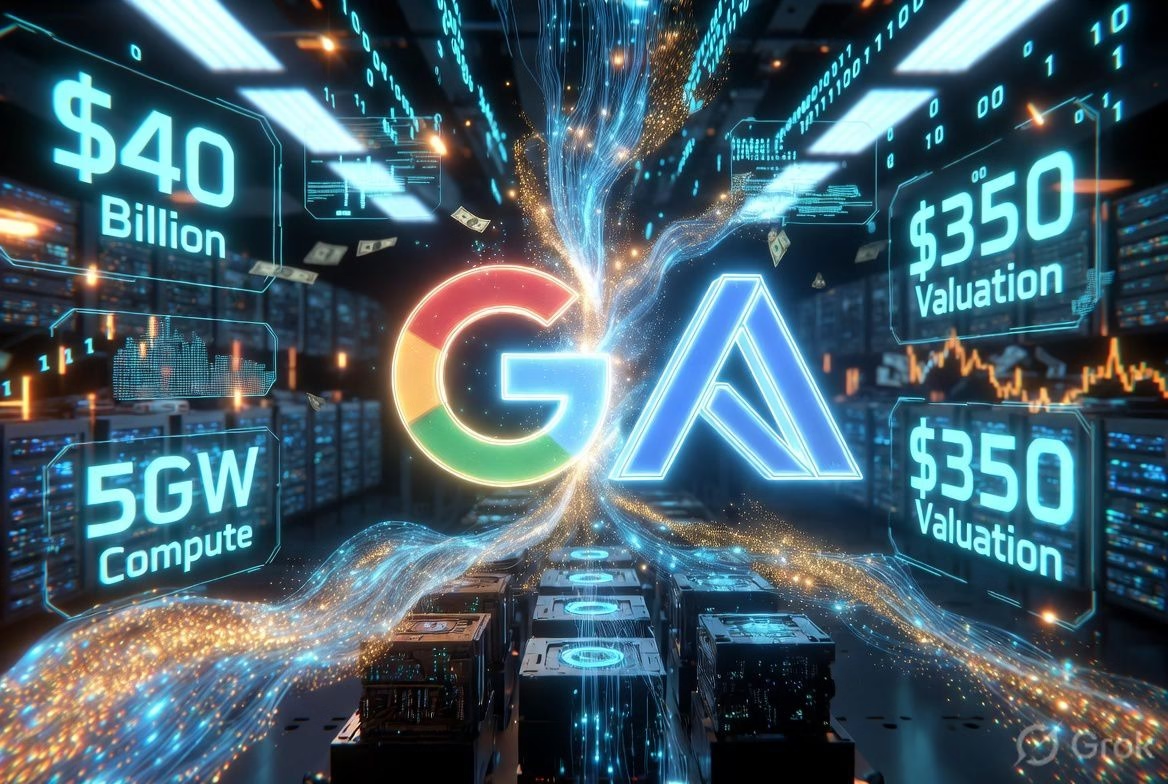
On April 24, 2026, Google (through its parent company Alphabet) and Anthropic made headlines with a major announcement: Google plans to invest up to $40 billion in Anthropic, the San Francisco-based company best known for its Claude family of AI models.
This isn’t just another funding round. It’s a strategic deepening of a relationship that has existed for years one that blends competition with heavy interdependence. Google is putting $10 billion in cash on the table immediately, with the potential for another $30 billion if Anthropic hits specific (but undisclosed) performance milestones.
For anyone trying to understand where the AI industry is headed in 2026 and beyond, this deal offers a window into the economics of frontier AI development, the critical role of compute power, and how cloud giants like Google are positioning themselves in an increasingly crowded field.
In this in-depth guide, we’ll break down every aspect of the Google-Anthropic investment: the financial terms, the compute commitments, the historical context, the strategic motivations on both sides, comparisons with other big deals (like those with Amazon), potential implications for the broader market, and what it might mean for businesses and everyday users of tools like Claud.
Table of Contents
Who Is Anthropic? A Quick but Important Background
To appreciate the scale of this investment, it helps to understand Anthropic’s journey. The company was founded in 2021 by Dario Amodei (former VP of Research at OpenAI) along with other ex-OpenAI executives. From the start, Anthropic positioned itself as a leader in constitutional AI an approach that emphasizes safety, alignment with human values, and reducing harmful outputs through structured principles rather than just scaling models aggressively.
Claude, Anthropic’s flagship model series, quickly gained a reputation for being helpful, thoughtful, and less prone to hallucination or toxic responses compared to some competitors. By 2025–2026, Claude had become especially popular in enterprise settings, particularly for coding tasks with products like Claude Code, which has seen explosive adoption among developers and businesses.
Anthropic’s growth has been remarkable. Its enterprise customer base (companies spending over $1 million annually) reportedly doubled in recent months. Revenue run rate has climbed into the tens of billions, driven by demand for reliable, secure AI tools that can be integrated into mission-critical workflows.
This success comes with huge challenges, though. Training and serving ever-larger models requires enormous amounts of computing power, specialized hardware, and electricity. That’s where partnerships with cloud providers like Google and Amazon become essential.
Breaking Down the Google Anthropic Investment Terms
Let’s get into the specifics of the April 2026 deal, based on statements from both companies and reporting from reliable outlets.
- Immediate Cash Investment: Google is committing $10 billion right away. This is provided at a $350 billion valuation for Anthropic, which aligns with the pre-money valuation from the company’s February 2026 funding activities.
- Contingent Additional Funding: Up to $30 billion more could follow, but only if Anthropic meets certain performance targets. The exact milestones haven’t been made public — they could relate to revenue growth, model performance benchmarks, customer adoption, or technical achievements like improved reasoning or safety metrics. This structure is common in big AI deals; it aligns incentives and reduces risk for the investor.
- Total Potential Commitment: Up to $40 billion from Google in this single agreement.
- Valuation Context: In February 2026, Anthropic closed a $30 billion Series G round at a $380 billion post-money valuation, led by investors including GIC (Singapore’s sovereign wealth fund) and Coatue, with participation from others like D.E. Shaw Ventures and Founders Fund.0b7652 The Google deal uses a slightly lower $350 billion figure for the immediate tranche, which is not unusual when structuring performance-based investments.
This brings Google’s total historical investment in Anthropic (including earlier rounds) to well over $13 billion, making it one of the startup’s largest backers alongside Amazon.
The deal also expands existing commercial agreements. Google Cloud will provide Anthropic with 5 gigawatts (GW) of computing capacity over the next five years, with potential to scale even further. To put that in perspective: 1 GW is roughly enough electricity to power about 750,000 average U.S. homes. Five GW is an enormous amount of power equivalent to powering all the homes in a state like Minnesota.
This compute expansion builds directly on earlier partnerships. In October 2025, Anthropic announced plans to use up to one million of Google’s Tensor Processing Units (TPUs), bringing over 1 GW online in 2026. Then in early April 2026, Anthropic, Google, and Broadcom revealed a multi-gigawatt agreement for next-generation TPUs expected to come online starting in 2027.
The Compute Arms Race: Why Infrastructure Matters More Than Ever
One of the most fascinating parts of the Google Anthropic investment isn’t just the cash it’s the infrastructure component. AI development has shifted from being primarily about algorithms and data to being heavily constrained by compute, energy, and specialized hardware.
Google’s TPUs are custom-designed chips optimized for AI workloads, often more power-efficient for certain tasks than general-purpose GPUs from Nvidia. By securing dedicated capacity on Google Cloud, Anthropic can train and serve Claude more reliably and at scale, while Google strengthens its position as a premier AI infrastructure provider.
The 5 GW commitment is particularly significant because energy availability and data center capacity have become bottlenecks. Building new power infrastructure takes years and faces regulatory, environmental, and supply chain hurdles. By locking in this capacity early, Anthropic gains a competitive edge, and Google gains a major long-term customer for its cloud services.
Comparison with Amazon’s Investments in Anthropic
To understand the full picture, it’s useful to compare Google’s move with Amazon’s recent actions. Just days before the Google announcement (on April 20, 2026), Amazon revealed plans to invest up to $25 billion more in Anthropic: $5 billion upfront and up to $20 billion additional based on milestones.
This brought Amazon’s total investment to around $13 billion. In return, Anthropic committed to spending over $100 billion on AWS services over the next decade, securing up to 5 GW of new compute capacity.
Both Google and Amazon deals highlight the same trend: AI startups are trading equity and future cloud spend for massive capital and guaranteed infrastructure. The performance-based tranches protect the investors if growth slows, while giving Anthropic flexibility to scale aggressively if it continues hitting targets.
Anthropic now has substantial backing from both major cloud providers, plus sovereign wealth funds and venture firms. Total funding raised exceeds $70 billion across rounds, making it one of the most capitalized AI companies ever.
Some reports even mentioned investor interest at valuations above $800 billion, though Anthropic has reportedly rebuffed some of those offers to maintain disciplined growth.
Strategic Motivations: Why Google Is Doubling Down
From Google’s perspective, several factors likely drove this decision:
1. Strengthening Google Cloud:
The AI infrastructure market is booming. By providing TPUs and capacity to Anthropic, Google not only earns revenue from usage but also gains valuable real-world feedback to improve its hardware and software stack.
2. Diversifying AI Bets:
While Google invests heavily in its own Gemini models, backing Anthropic provides exposure to a different architectural and safety philosophy. This reduces risk if one approach hits limitations.
3. Talent and Knowledge Flow:
Long-term partnerships often lead to informal exchanges of ideas and potential future recruitment opportunities.
4. Competitive Pressure:
With Microsoft deeply tied to OpenAI and Amazon ramping up its own Anthropic relationship, Google needs to stay relevant in the frontier AI ecosystem.
For Anthropic, the benefits are straightforward: more capital to fund research, product development (especially in coding and agentic AI), and the compute needed to keep Claude at the cutting edge. CEO Dario Amodei has consistently emphasized responsible scaling, and this funding provides the runway to do so without compromising on safety research.
Broader Implications for the AI Industry in 2026
This deal reflects several larger trends:
- Capital Concentration: Only a handful of players can afford to develop and deploy frontier models. We’re seeing a shift toward oligopolistic structures where big tech and well-funded startups dominate.
- Infrastructure as the New Moat: Model performance differences are narrowing; sustainable competitive advantage increasingly comes from access to power, chips, and data centers.
- Energy and Geopolitics: With much of the new capacity being built in the United States, these deals align with national priorities around maintaining AI leadership. Anthropic has publicly committed to significant domestic infrastructure investment.
- Safety and Regulation: Anthropic’s focus on constitutional AI and responsible deployment continues to differentiate it. How this investment affects safety priorities will be watched closely by policymakers and ethicists.
- Potential IPO Path: With such massive funding and revenue growth, Anthropic could be preparing for a public listing in the coming years. These strategic investments from Google and Amazon provide credibility and liquidity options.
There are risks too. Heavy reliance on a few cloud providers could create vulnerabilities if relationships sour or if pricing/power dynamics shift. Market concentration also raises antitrust questions, though regulators have so far taken a relatively hands-off approach to AI investments compared to traditional tech mergers.
What This Means for Businesses and Users of Claude
For companies already using or considering Claude:
- Improved Reliability and Scale: More compute usually translates to faster responses, higher availability, and the ability to handle more complex tasks without degradation.
- New Features: Funding accelerates development in areas like advanced coding assistants, multi-step reasoning agents, and enterprise security features.
- Pricing Stability: While not guaranteed, strong infrastructure backing can help keep costs predictable as demand grows.
- Ecosystem Integration: Deeper Google Cloud ties may lead to smoother integrations with Google Workspace, BigQuery, and other tools.
Everyday users might notice incremental improvements in Claude’s helpfulness, creativity, and safety guardrails over time.
Potential Challenges and Open Questions
No deal this large is without uncertainties:
- What exact performance milestones unlock the extra $30 billion? Revenue targets? Model benchmarks? Safety metrics?
- How will the influx of capital affect Anthropic’s culture and focus on responsible AI?
- Could increased interdependence with Google influence product roadmaps or neutrality?
- What about environmental impact? Training at this scale consumes massive electricity how are the companies addressing sustainability?
Anthropic and Google have not provided detailed public answers to these yet, which is typical for competitive deals. As more information emerges, the picture will become clearer.
Conclusion: A Defining Moment in the AI Ecosystem
Google’s commitment of up to $40 billion to Anthropic is more than a financial transaction it’s a signal of confidence in the continued rapid growth of safe, capable AI systems and the infrastructure needed to support them.
In an industry where costs are skyrocketing and competition is fierce, such mega-deals are likely to become more common. They reflect a maturing ecosystem where collaboration on compute and cloud services coexists with fierce rivalry on model capabilities.
For observers, investors, developers, and business leaders, this Google Anthropic investment offers valuable lessons: watch the infrastructure plays as closely as the model benchmarks, understand the power of performance-based funding structures, and recognize that access to energy and specialized chips may determine winners as much as brilliant algorithms.
What are your thoughts on this massive Google-Anthropic deal? Does it change how you view the balance between competition and collaboration in AI? Or how it might affect the tools you use daily? Share your perspectives in the comments below I’d love to hear them.
If you found this breakdown helpful, consider subscribing to our newsletter for more in-depth analysis of AI investments, technology strategy, and emerging trends in 2026 and beyond.